
Casement windows are one of the most versatile window styles used in modern residential and commercial projects. They swing outward (or inward in some regions) and offer excellent ventilation, energy efficiency, and unobstructed views. To ensure the perfect fit and performance, it’s important to understand casement window dimensions—standard sizes, minimum and maximum limits, and custom options.
This guide provides a complete overview for homeowners, architects, and builders.
Standard Casement Window Size Chart
Although casement window sizes vary by manufacturer, most fall within common industry ranges. Below is a general size chart for single and double casement windows.
Single Casement Window Sizes
| Width (inches) | Height (inches) |
|---|---|
| 18″ | 24″–48″ |
| 20″ | 24″–60″ |
| 24″ | 36″–72″ |
| 28″ | 36″–72″ |
| 32″ | 48″–84″ |
| 36″ | 48″–84″ |
Double (French) Casement Window Sizes
| Total Width (inches) | Height (inches) |
|---|---|
| 36″–48″ | 36″–60″ |
| 48″–60″ | 48″–72″ |
| 60″–72″ | 60″–84″ |
These dimensions cover the most commonly used sizes for residential casement windows.
If you’re interested in sliding window sizes, please visit: https://cnwindowsdoors.com/sliding-window-sizes-a-complete-guide/
Typical Casement Window Sizes
The most frequently ordered casement window sizes fall in the medium-width and mid-height range because they balance ventilation and structural stability.
Common typical sizes include:
- 24″ × 48″
- 24″ × 60″
- 30″ × 60″
- 36″ × 72″
- 60″ × 72″ (double casement)
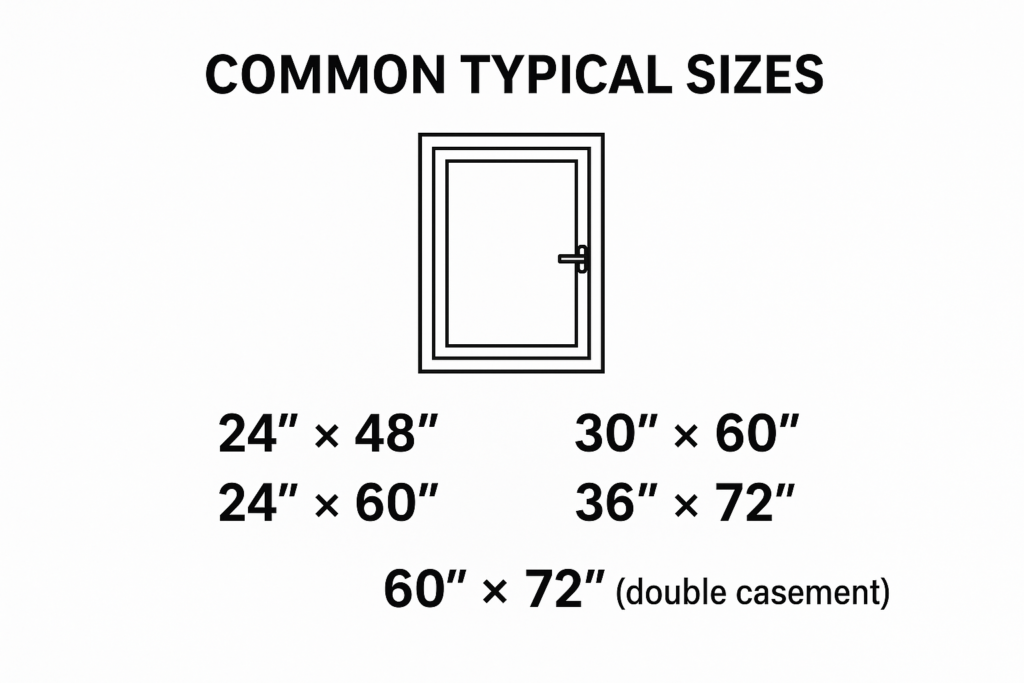
These sizes suit bedrooms, kitchens, stairwells, and living rooms. Their dimensions allow easy operation while providing generous daylight and airflow.
Custom Size Casement Windows
For unique architectural designs or special performance requirements, custom casement window sizes are widely available.
Why Choose Custom Sizes?
- Non-standard wall openings
- Oversized facade designs
- Matching existing windows in renovation projects
- Enhanced ventilation or lighting
- Aesthetic uniformity in villa and luxury projects
What Can Be Customized?
- Width and height
- Frame thickness
- Sash configuration (single, double, or triple)
- Glass type and thickness
- Arc-top or special-shaped casements
- Heavy-duty hardware for large windows
High-quality aluminum systems (like those from Delanshini Doors and Windows) support excellent performance even in large custom configurations.
Maximum Casement Window Size
The maximum size of a casement window depends on:
- Frame material
- Hardware strength
- Glass weight
- Wind load requirements
Typical Maximum Sizes
- Single Casement Window:
Up to 36″–42″ wide × 84″–96″ high - Double/French Casement Window:
Up to 72″–84″ wide × 84″–96″ high
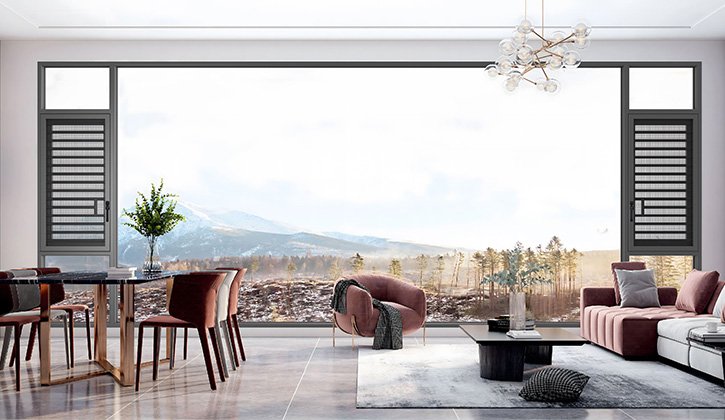
Aluminum profiles allow larger sizes compared with wood or uPVC because of their strength and stability. For very large casement windows, reinforced hinges and multi-point locking systems are required.
Minimum Casement Window Size
Some rooms require small casement windows, such as bathrooms or narrow walls. However, casement windows cannot be too small, or the hardware cannot function properly.
Typical Minimum Sizes
- Single Casement Window:
Minimum around 16″–18″ wide × 20″–24″ high - Double Casement Window:
Minimum around 32″–36″ wide × 24″–30″ high
Below these dimensions, ventilation panels, awning windows, or fixed windows are usually recommended instead.
Conclusion
Casement window dimensions significantly influence the performance, comfort, and style of your space. Understanding standard, typical, minimum, and maximum casement window sizes helps you select the right window for any room. Whether you’re working with conventional openings or custom architectural designs, casement windows offer exceptional flexibility.
For custom casement window manufacturing, size consultation, or design support, feel free to contact us:
Email: wang@gddlsn.com
FAQ
What are standard casement window sizes?
Standard casement window sizes typically range from 1 foot 7 inches to 2 feet 11 inches in width and 2 feet 5 inches to 6 feet 5 inches in height. However, exact dimensions may vary depending on the manufacturer and window configuration.
What is the most common casement window size?
One of the most common casement window sizes is 24 × 36 inches, although 24 × 48 inches, 30 × 60 inches, and 36 × 72 inches are also widely used in residential projects.
What is the maximum size for a casement window?
The maximum size depends on the frame material, glass type, and hardware system. Aluminum casement windows can generally support larger dimensions than vinyl windows because of aluminum’s structural strength.
What is the minimum size for a casement window?
Small casement windows can be as narrow as 16 inches wide and 24 inches high. Compact sizes are commonly used in bathrooms, stairwells, and utility rooms.
How do you measure a casement window?
To measure a casement window, measure the width and height of the window opening from inside the frame. Measurements should be taken at multiple points to ensure accuracy, especially for replacement windows.
What is the rough opening for a casement window?
The rough opening is usually slightly larger than the actual window frame size to allow space for installation and adjustment. Exact rough opening dimensions depend on the manufacturer’s specifications.
Are casement windows available in custom sizes?
Yes. Casement windows can be customized in different widths, heights, frame colors, glass types, and opening configurations to fit various architectural requirements.
What size casement window is best for bedrooms?
Larger casement windows are commonly used in bedrooms to provide natural light, ventilation, and emergency egress access where required by building codes.
What size casement window is best for bathrooms?
Smaller or medium-sized casement windows are often preferred for bathrooms because they provide ventilation while maintaining privacy.
Can casement windows be used for egress?
Yes. Casement windows are often used as egress windows because they can open fully, creating a larger clear opening for emergency escape requirements.
Are double casement windows larger than single casement windows?
Yes. Double casement windows combine two operable sashes, allowing for wider window openings and improved ventilation compared to single casement windows.
What frame materials are available for large casement windows?
Large casement windows are commonly manufactured with aluminum, uPVC/vinyl, fiberglass, or wood frames. Aluminum is especially popular for oversized modern window designs because of its strength and slim profiles.