
When installing or replacing a door, understanding the standard door opening size is extremely important. The door opening affects not only the installation process but also the door’s appearance, operation, insulation, and long-term performance.
This guide explains standard residential door opening sizes, rough openings, and how to determine the correct dimensions for different types of doors.
What Is a Door Opening?
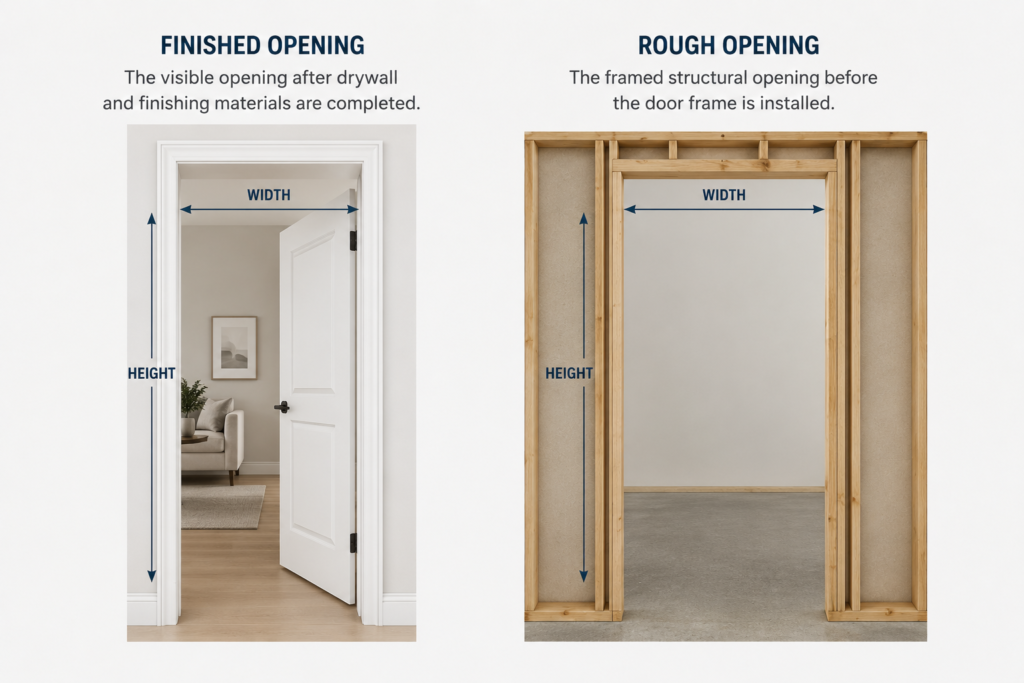
A door opening is the space prepared in the wall for installing a door and its frame. There are two common terms used in construction:
Finished Opening
The visible opening after drywall and finishing materials are completed.
Rough Opening
The framed structural opening before the door frame is installed.
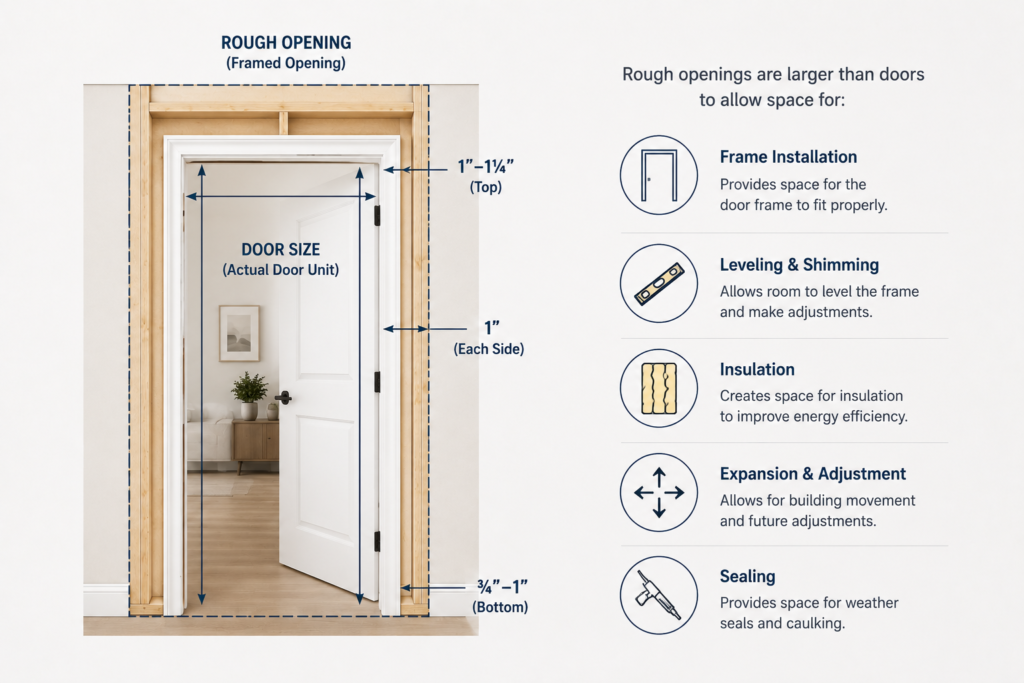
The rough opening is always slightly larger than the actual door size to allow room for adjustment and installation.
Why Rough Openings Are Larger Than Doors
The rough opening must be larger than the actual door unit to allow space for:
- Door frame installation
- Leveling and shimming
- Insulation
- Expansion and adjustment
A common rule is:
- Add about 2 inches to the width
- Add about 2 to 2.5 inches to the height
However, exact requirements may vary depending on the manufacturer and door system.
Standard Front Door Opening Size
The most common front door size in residential homes is:
- 36″ × 80″
For this door size, the recommended rough opening is usually:
- 38″ × 82.5″
Common Front Door Opening Sizes
| Door Size | Rough Opening Size |
|---|---|
| 32″ × 80″ | 34″ × 82.5″ |
| 36″ × 80″ | 38″ × 82.5″ |
| 42″ × 80″ | 44″ × 82.5″ |
Modern homes may also use taller 84-inch or 96-inch entry doors.
Standard Interior Door Opening Size
Interior doors are usually smaller than exterior doors.
Common interior door sizes include:
| Door Size | Rough Opening Size |
|---|---|
| 24″ × 80″ | 26″ × 82″ |
| 28″ × 80″ | 30″ × 82″ |
| 30″ × 80″ | 32″ × 82″ |
| 32″ × 80″ | 34″ × 82″ |
| 36″ × 80″ | 38″ × 82″ |
Most interior doors are:
- 80 inches high
- 1-3/8 inches thick
Standard Double Door Opening Size
Double doors require larger openings because they include two door panels.
Common Double Door Opening Sizes
| Door Size | Rough Opening Size |
|---|---|
| 60″ × 80″ | 62″ × 82.5″ |
| 72″ × 80″ | 74″ × 82.5″ |
| 96″ × 80″ | 98″ × 82.5″ |
Double doors are commonly used for:
- Front entrances
- French doors
- Patio doors
Standard Sliding Door Opening Size
Sliding patio doors are wider than standard hinged doors.
Typical sliding door opening sizes include:
| Sliding Door Size | Rough Opening Size |
|---|---|
| 60″ × 80″ | 62″ × 82.5″ |
| 72″ × 80″ | 74″ × 82.5″ |
| 96″ × 80″ | 98″ × 82.5″ |
Large modern sliding doors may require custom structural support.
Standard French Door Opening Size
French doors are one of the most common double-door systems in residential homes.
Common French Door Opening Sizes
| French Door Size | Rough Opening Size |
|---|---|
| 60″ × 80″ | 62″ × 82.5″ |
| 72″ × 80″ | 74″ × 82.5″ |
| 96″ × 80″ | 98″ × 82.5″ |
Exterior French doors usually require additional space for thresholds and weather sealing.
How to Measure a Door Opening
Accurate measurements are essential before ordering a new door.
Step 1: Measure the Width
Measure the opening at:
- Top
- Middle
- Bottom
Use the smallest measurement.
Step 2: Measure the Height
Measure from the floor to the top of the opening at:
- Left side
- Center
- Right side
Use the shortest measurement.
Step 3: Measure the Wall Thickness
Measure the wall or jamb depth to ensure frame compatibility.
Common Mistakes to Avoid
Avoid these common mistakes when measuring a door opening:
- Measuring only the old door slab
- Ignoring rough opening dimensions
- Forgetting floor height changes
- Ignoring wall thickness
- Choosing oversized doors without checking structural support
Careful planning helps ensure proper installation and long-term performance.
Conclusion
The standard door opening size for a house depends on the door type and application. Most residential front doors use a rough opening of approximately 38″ × 82.5″ for a standard 36″ × 80″ door.
Understanding standard rough opening sizes helps simplify door replacement and installation projects while reducing costly mistakes.
If you are looking for high-quality residential doors for modern or traditional homes, Delanshini Doors and Windows offers a wide range of customizable door solutions. For detailed specifications and quotations, please contact: wang@gddlsn.com