
Interior French doors are hinged doors with glass panels that separate rooms while allowing natural light and maintaining a visual connection between spaces. They are available as single or double doors, with different glass styles, lite patterns, materials, finishes, and core constructions.
Choosing the right interior French door depends on the room, available opening, desired privacy, glass configuration, door construction, and installation requirements.
What Are Interior French Doors?
Interior French doors are typically hinged doors that incorporate one or more glass panels, known as lites, into the door design. The glass allows light to pass between rooms while the door still provides physical separation.
Although French doors are commonly associated with a pair of doors, interior French doors can be either single or double doors. A single French door can work well where a standard doorway is required, while a double configuration provides a wider opening and a more prominent architectural appearance.
They are commonly used between living areas, home offices, dining rooms, bedrooms, studies, and hallways.
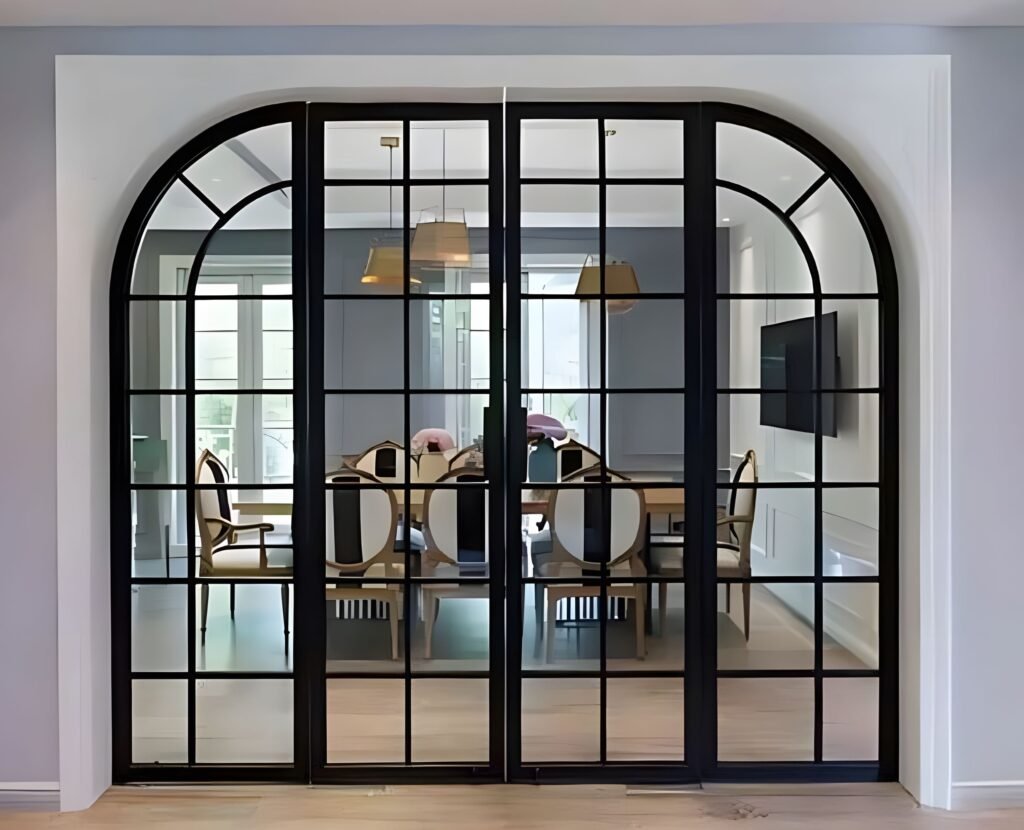
Interior French Doors at a Glance
| Feature | Common Options |
|---|---|
| Configuration | Single or double |
| Opening type | Hinged swing door |
| Glass | Clear, frosted, obscure, decorative |
| Lite patterns | Full lite, 3-lite, 5-lite, 6-lite, 10-lite, 12-lite, 15-lite and more |
| Materials | Wood, engineered wood, MDF/composite |
| Core | Hollow core or solid core |
| Installation | Slab or pre-hung |
| Common height | 80 inches, with 84- and 96-inch options also available |
| Common applications | Home offices, living rooms, dining rooms, bedrooms, studies, hallways |
The exact combinations vary by manufacturer, so check the product specifications before ordering.
Types of Interior French Doors
1. Single Interior French Doors
A single French door uses one hinged door leaf and is installed in a conventional doorway.
It is a practical option when you want the appearance and light transmission of a French door without requiring the wider opening needed for a double-door configuration.
Single French doors are particularly suitable for:
- Home offices
- Bedrooms
- Studies
- Bathrooms
- Hallways
- Small living spaces
2. Double Interior French Doors
Double French doors use two door leaves that meet at the center of the opening.
They provide a wider passage and can create a stronger visual connection between adjoining rooms. They are often used for larger openings between living rooms, dining rooms, offices, and other shared spaces.
When choosing double French doors, consider both the total unit width and the width of each individual door leaf.
3. Full-Lite French Doors
Full-lite doors have a large glass area extending through most of the door.
They maximize light transmission and visibility, making them useful when the main objective is to visually connect two spaces.
Clear full-lite glass provides the greatest visibility, while frosted or obscure glass can reduce direct visibility.
4. Multi-Lite French Doors
Multi-lite French doors divide the glass area into several smaller sections using horizontal and/or vertical muntins.
Common configurations include 3-lite, 5-lite, 6-lite, 10-lite, and other patterns.
The number of lites primarily affects the appearance of the door and the proportion of glass to framing. A higher number of smaller panes can create a more traditional appearance, while larger glass sections generally create a cleaner, more contemporary look.
5. Shaker and Panel French Doors
Some interior French doors combine glass with solid raised or recessed panels.
For example, a door may have glass in the upper section and one or more solid panels below it. This design provides a balance between natural light and a more substantial traditional door appearance.
Shaker-style designs are particularly suitable for interiors that already use simple rectangular trim and cabinetry.
6. Modern and Industrial French Doors
Modern interior French doors often use simple frames, large glass areas, and minimalist hardware. Black or dark finishes are frequently used to create a stronger contrast with the glass.
Industrial-style designs may emphasize multiple glass panes and narrow visual frames, making them suitable for contemporary offices, studios, and open-plan interiors.
Glass Options for Interior French Doors
Glass selection is one of the most important decisions because it determines how much light and visibility the door provides.
Clear Glass
Clear glass provides the highest level of visibility between rooms and allows substantial natural or artificial light to pass through.
It works well for:
- Home offices
- Living rooms
- Dining rooms
- Studies
- Areas where visual connection is important
The main limitation is privacy. People can generally see through the door from either side.
Frosted Glass
Frosted glass diffuses light and significantly reduces direct visibility.
It is a common choice for rooms where you want natural light without a completely open view. This makes it suitable for home offices, bedrooms, bathrooms, and other spaces where additional visual privacy is useful.
Obscure Glass
Obscure glass uses a patterned or textured surface to reduce visibility.
The level of privacy depends on the specific glass pattern and lighting conditions, so “obscure” does not necessarily mean completely opaque.
Decorative Glass
Decorative glass can include patterns, textures, or other visual treatments.
It is generally selected when appearance is as important as light transmission and privacy. The specific level of visibility depends on the glass design.
When choosing glass, think about the balance between three factors: light, visibility, and privacy. Clear glass prioritizes visibility, while frosted and obscure glass shift the balance toward privacy.

What Materials Are Used for Interior French Doors?
Interior French doors are available in several construction materials.
Wood
Wood doors offer a natural appearance and can be stained or finished to complement the surrounding interior.
They are often selected for traditional, premium, or custom interior applications.
Engineered Wood
Engineered wood constructions can provide consistent dimensions and surface characteristics while offering a range of finishes.
They are commonly used when appearance, dimensional stability, and manufacturing consistency are important.
MDF and Composite Materials
MDF and composite constructions are also used for interior doors, particularly paint-grade products.
They can provide a smooth, uniform surface and are available in a wide range of styles. The exact construction and performance depend on the product.
Solid Core vs. Hollow Core French Doors
The door core affects weight, feel, durability, and sound performance.
| Feature | Solid Core | Hollow Core |
|---|---|---|
| Weight | Heavier | Lighter |
| Feel | More substantial | Lighter |
| Sound reduction | Generally better | Generally lower |
| Cost | Usually higher | Usually lower |
| Installation | Requires more handling | Easier to handle |
| Suitable for | Offices, bedrooms, premium interiors | Budget-conscious applications |
A solid-core French door can be a good choice when sound reduction and a substantial feel are priorities. A hollow-core option may make more sense when keeping weight and cost lower is more important.
However, sound performance does not depend on the core alone. Glass type, door construction, frame, seals, and installation also affect how much sound passes between rooms.
What Are the Standard Interior French Door Sizes?
The most common interior door height is 80 inches, while 84- and 96-inch options are also available. Standard widths vary depending on whether you choose a single or double configuration.
For single doors, common widths may include:
- 18 inches
- 24 inches
- 28 inches
- 30 inches
- 32 inches
- 36 inches
Double French doors can be configured in wider overall sizes, such as 48, 56, 60, 64, or 72 inches, depending on the manufacturer and design.
For example, a 60-inch double French door may consist of two 30-inch door leaves, while another configuration may use two 30-inch leaves within a different frame system.
Do not select a door based only on the nominal door size. Measure the existing opening and check the manufacturer’s requirements for the rough opening, jamb, door thickness, and installation clearance.
Custom sizes are also available from some manufacturers when standard dimensions do not fit the project.
Pre-Hung vs. Slab Interior French Doors
Another important decision is whether to purchase a pre-hung unit or a slab door.
Pre-Hung French Doors
A pre-hung door comes with the door mounted in a frame or jamb system, typically with hinges already prepared or installed.
It is generally suitable when you are replacing the entire door and frame or building a new opening.
Advantages:
- Door and frame are designed as a system
- Easier to achieve a coordinated installation
- Suitable for new construction or complete replacements
Slab French Doors
A slab is the door leaf without the complete frame.
It can be a practical choice when the existing frame is in good condition and you only need to replace the door.
Advantages:
- Can reuse an existing frame
- Useful for door replacement projects
- Often provides more flexibility when matching an existing opening
The key consideration is compatibility. A replacement slab must match the existing opening, hinge locations, thickness, handing, and other hardware requirements.
Where Can You Use Interior French Doors?
Home Office
Interior French doors are particularly useful for home offices because they define the workspace without completely disconnecting it from the rest of the home.
Clear glass maintains visibility, while frosted glass provides greater visual privacy.
Living Room
French doors can separate a living room from another space while maintaining a more open visual appearance than a solid door.
Dining Room
Double French doors can create a wider and more formal connection between a dining room and an adjacent living area.
Bedroom
For bedrooms, privacy should be considered carefully. Frosted, obscure, or decorative glass may be more appropriate than clear glass.
Study
A study can benefit from the natural light and visual connection provided by French doors while retaining a defined room boundary.
Hallway
Glass interior doors can help transfer light into darker hallways and make adjacent spaces feel more connected.
Pros and Cons of Interior French Doors
Advantages
- Allow light to pass between rooms
- Maintain a visual connection between spaces
- Available in single and double configurations
- Offer many glass and lite-pattern choices
- Work with traditional, transitional, and modern interiors
- Can create a more open feeling without removing the doorway
Disadvantages
- Clear glass provides limited privacy
- Glass requires regular cleaning
- Swing doors require sufficient floor clearance
- Some glass configurations can increase cost
- Heavier solid-core doors require more careful handling
- Sound control depends heavily on the complete door and frame assembly
Interior French Doors vs. Standard Interior Doors
| Feature | Interior French Doors | Standard Interior Doors |
|---|---|---|
| Glass | Usually one or more glass panels | Often solid |
| Natural light | Higher | Lower |
| Visual connection | High | Limited |
| Privacy | Depends on glass | Generally higher |
| Design options | Glass, lite patterns, panels, finishes | Panels, flush designs, finishes |
| Best for | Connecting spaces while maintaining separation | Privacy and stronger visual separation |
The choice is therefore less about which door is universally better and more about what the room needs.
If light and visual connection are priorities, French doors are often a strong option. If privacy and visual separation are more important, a solid interior door may be more appropriate.
How to Choose the Right Interior French Doors
1. Consider the Room
Start with where the door will be installed.
A home office may benefit from clear or frosted glass, while a bedroom may require greater privacy.
2. Decide Between Single and Double
Choose a single door when the existing opening is relatively narrow or when a conventional doorway is sufficient.
Choose double French doors when you want a wider opening or a more prominent architectural feature.
3. Select the Right Glass
Consider how much visibility and privacy the room requires.
- Clear: maximum visibility and light
- Frosted: more privacy with diffused light
- Obscure: reduced visibility with varied light transmission
- Decorative: design-focused appearance with varying privacy
4. Choose the Lite Pattern
The number and arrangement of glass panels significantly influence the appearance.
Fewer, larger panes tend to create a simpler appearance, while multiple smaller panes create a more traditional or divided-light look.
5. Compare Solid Core and Hollow Core
Consider sound, weight, durability, and budget.
For a home office or bedroom where sound reduction matters, solid core may be worth considering. For lighter-duty applications where cost and ease of handling are priorities, hollow core may be sufficient.
6. Measure the Opening
Measure the existing door, frame, rough opening, wall thickness, and available swing space.
For a replacement project, do not assume that the nominal door size is the same as the required rough-opening size.
7. Choose Pre-Hung or Slab
If the frame is being replaced, a pre-hung unit may simplify the project.
If the existing frame is suitable for reuse, a slab may be the more practical choice.
8. Match the Interior Style
Consider the existing flooring, trim, wall colors, cabinetry, and hardware.
White and natural wood finishes can create a traditional appearance, while black and other darker finishes can provide stronger contrast and a contemporary look.
9. Consider the Installation Space
Because most interior French doors are hinged, make sure there is enough space for the door leaves to swing without interfering with furniture, walls, cabinets, or other doors.
FAQs
1. What are interior French doors?
Interior French doors are hinged interior doors that incorporate glass panels. They separate rooms while allowing light and, depending on the glass, visibility between spaces.
2. Are interior French doors a good idea?
They can be an excellent choice when you want to separate rooms while maintaining natural light and a visual connection. They may be less suitable when maximum privacy is required.
3. Are French doors good for privacy?
Privacy depends largely on the glass. Clear glass offers little visual privacy, while frosted, obscure, or some decorative glass options provide greater privacy.
4. Do interior French doors let in more light?
Yes. The glass panels allow light to pass between rooms, which can help brighten spaces that receive limited direct light.
5. What is the standard size of an interior French door?
An 80-inch height is common for interior doors, with 84- and 96-inch options also available. Widths vary by single or double configuration and manufacturer.
6. Can you have a single interior French door?
Yes. French doors are available as both single and double configurations.
7. Are French doors the same as double doors?
Not necessarily. “Double door” describes a two-door configuration, while “French door” generally refers to a door design incorporating glass panels. A double French door is therefore one type of double door.
8. What is better, clear or frosted glass?
Clear glass is better when visibility and maximum visual openness are desired. Frosted glass is better when you want light transmission with greater visual privacy.
9. Are solid-core French doors better?
Solid-core doors generally provide a more substantial feel and better sound reduction than hollow-core doors, but they are also heavier and typically more expensive. The right choice depends on the application.
10. Should I choose a pre-hung or slab French door?
Choose pre-hung when you are replacing or installing the frame and door together. Choose a slab when the existing frame is suitable for reuse.
11. Are interior French doors suitable for home offices?
Yes. They can separate a home office from the rest of the house while maintaining light and visual connection. Frosted glass is useful when additional privacy is needed.
12. How do I measure for interior French doors?
Measure the existing door and frame, then verify the rough opening, jamb dimensions, door thickness, and available swing space against the manufacturer’s specifications. For new construction, follow the manufacturer’s rough-opening requirements rather than relying only on the nominal door size.
Final Thoughts
Interior French doors provide a practical way to divide rooms without completely closing them off visually. The most important choices are door configuration, glass type, size, core construction, and installation method.
For the best result, select the door based on the room’s privacy, lighting, opening dimensions, interior style, and installation requirements rather than appearance alone.
Looking for the right interior French doors for your project? Email us at wang@gddlsn.com to discuss your requirements.