
Yes, French doors can have screens. The best option depends on how your doors open, how often you use them, the size of the opening, your budget, and how important appearance is to you. Retractable screens are often the cleanest solution for double French doors because they can cover the full opening and disappear when not in use. Hinged, magnetic, and sliding screen options are also available for specific configurations.
This guide explains the main French door screen options, their advantages and limitations, typical costs, sizing considerations, and how to choose the right system for your home.
Can French Doors Have Screens?
Yes. French doors can be paired with several types of screen systems to let in fresh air while keeping insects outside.
The challenge is that French doors usually consist of two swinging panels. A conventional screen door can interfere with the movement of the French doors, especially when the doors swing outward. A screen system therefore needs to work independently from the door panels.
The main options include:
- Retractable screens
- Hinged screen doors
- Magnetic mesh screens
- Sliding screen systems
- Integrated screen systems supplied with some door assemblies
For most modern French door installations, retractable screens provide the best combination of appearance, flexibility, and usability. However, a different option may make more sense for a low-traffic doorway, a temporary installation, or a project with a limited budget.
Types of Screens for French Doors
1. Retractable Screens
Retractable screens are designed to pull across the French door opening when needed and roll or fold into a slim housing when not in use.
For double French doors, the most common configuration uses two screen panels. Each panel retracts into a housing on one side of the opening, and the two panels meet in the center.
This configuration works particularly well because the screen does not need to compete with the movement of the French doors.
Advantages:
- Disappears when not in use
- Preserves the appearance of the French doors
- Can work with inswing and outswing doors
- Covers the complete double-door opening
- Available in custom sizes
- Suitable for frequently used exterior doors
Limitations:
- Usually costs more than basic magnetic or hinged screens
- Requires accurate measurements
- Track and housing installation must be properly aligned
- Large openings may require a specialized system
Retractable systems are currently one of the most common solutions recommended for French doors because they address the basic problem of screening a wide, swinging opening without permanently blocking it.
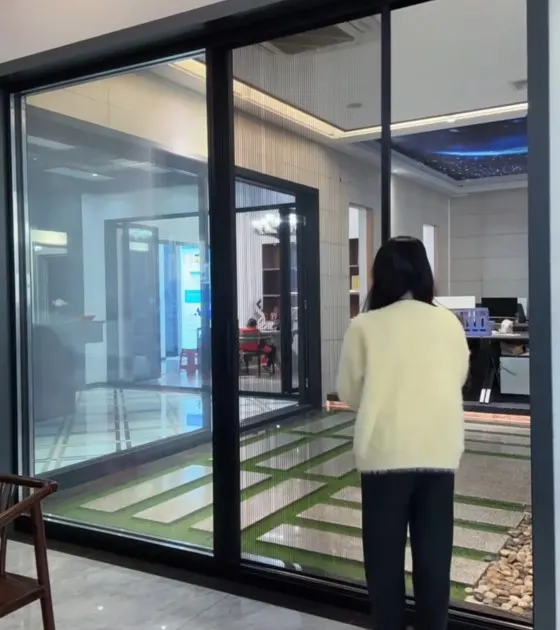
2. Hinged Screen Doors
Hinged screen doors work much like conventional exterior doors. For a pair of French doors, two screen panels can be installed to correspond with the two door panels.
They are a relatively straightforward and durable option, particularly when the configuration provides enough clearance for the screen panels to swing.
Advantages:
- Simple construction
- Durable frame
- Easy to operate
- Available in aluminum, wood, and other materials
- Can provide a traditional appearance
Limitations:
- Always visible
- Requires additional swing clearance
- Can interfere with the French doors
- Less suitable for some outswing configurations
- The frames can change the clean appearance of a large glass opening
Hinged screens can make sense when durability and simplicity matter more than a completely unobstructed appearance.
3. Magnetic Mesh Screens
Magnetic mesh screens are one of the least expensive ways to screen French doors.
The mesh is generally attached around the opening, with magnetic closures meeting along the center seam. Users can walk through the center and the magnets close the opening afterward.
Advantages:
- Low cost
- Easy installation
- Minimal tools required
- Suitable for temporary or seasonal use
- Easy to remove
Limitations:
- Less durable than framed systems
- Can move or billow in strong wind
- Center closure can wear with heavy use
- Usually looks less integrated
- May not be the best choice for premium exterior doors
Magnetic screens can be practical for a rental property, seasonal application, or budget-conscious project. They are less suitable when you expect the screen to withstand heavy daily traffic for many years.
4. Sliding Screen Doors
Sliding screens are common with sliding patio doors, but they require more careful consideration with French doors.
A sliding screen needs a track and operates separately from the swinging door panels. Some manufacturers offer French-style patio door systems that combine swinging panels with a companion sliding screen.
However, a conventional sliding screen is not automatically compatible with every French door opening.
Advantages:
- Smooth operation when properly designed
- Familiar sliding-door operation
- Suitable for certain patio door systems
- Can work well with factory-designed door assemblies
Limitations:
- Requires track space
- Not suitable for every swinging French door
- May obstruct part of the opening
- More difficult to retrofit onto an existing French door
For a standard pair of swinging French doors, a retractable system is usually more flexible than simply adding a conventional sliding screen.
French Door Screen Options Compared
| Screen Type | Appearance | Durability | Installation | Best For | Main Limitation |
|---|---|---|---|---|---|
| Retractable | Excellent | High | Moderate | Most French doors | Higher cost |
| Hinged | Good | High | Moderate | Traditional homes and high use | Needs swing clearance |
| Magnetic | Fair | Low–Moderate | Easy | Budget and seasonal use | Less durable |
| Sliding | Good | Moderate–High | Moderate | Compatible patio systems | Requires track space |
The right choice depends less on the screen itself than on the relationship between the screen, the door swing, the opening size, and how the doorway is used.
Retractable Screens: Double vs. Single
If you choose a retractable system, you may have another decision to make: should you use two screens or one screen across the entire opening?
Double Retractable Screens
A double system has one screen housing on each side of the French door opening.
The two screens pull toward the center and meet when the entire opening needs to be screened.
A common configuration allows one screen to remain fixed while the other is used for everyday passage. When both French door panels are open, both screen panels can be deployed to cover the full opening.
This configuration is particularly suitable for:
- High-traffic patio doors
- Backyard entrances
- Frequently used exterior doors
- Wide openings
- Homes where both French door panels are regularly opened
Double retractable systems are widely used for French doors because each screen can correspond to one side of the opening.
Single Long-Pull Screen
A single long-pull system uses one housing on one side and pulls across the entire opening.
Its main advantage is simplicity. You have only one cassette instead of two, so the frame can look cleaner when the screen is retracted.
The limitation is width. The maximum opening depends on the manufacturer and system. For example, ClearView currently lists a long-pull system for openings up to 68 inches, while Apollo lists a maximum width of 65 inches for its long-pull French door system.
Which Is Better?
| Situation | Better Option |
|---|---|
| Frequently use both doors | Double retractable |
| High-traffic entrance | Double retractable |
| One door is used most of the time | Double retractable with one active side |
| Smaller opening | Single long-pull may work |
| Want only one housing | Single long-pull |
| Maximum flexibility | Double retractable |
| Very wide opening | Custom double system |
The available opening width and the manufacturer’s maximum screen size should always be confirmed before choosing a single-screen configuration.
Can Screens Work With Inswing and Outswing French Doors?
Yes, but the installation arrangement changes depending on the direction of the door swing.
Inswing French Doors
With inswing French doors, the door panels open toward the interior.
A retractable screen can typically be mounted on the interior side of the frame so that it operates independently of the door panels.
This configuration is common and gives the screen enough separation from the door swing to operate correctly.
Outswing French Doors
Outswing French doors open toward the exterior.
A conventional hinged screen can create a clearance problem because both the French door and screen may compete for the same exterior space.
A retractable screen can solve this problem because the screen is mounted independently of the door panels. Depending on the system, the screen housing can be positioned on the exterior side of the opening.
Manufacturers such as Apollo specifically offer retractable configurations for both inswing and outswing French doors.
Before installation, check the door swing, surrounding trim, sill, exterior wall conditions, and available mounting space.
French Door Screen Sizes and How to Measure
There is no single universal French door screen size. The correct screen dimensions depend on the actual opening and the specific screen system.
French doors may also settle over time, and the two panels may not remain perfectly identical. For this reason, measuring the actual opening is more reliable than assuming both sides are exactly the same.
Measure the Width
Measure the opening width at several points:
- Top
- Middle
- Bottom
Record the smallest measurement.
For a double French door, also determine whether the two door panels are equal in width and where the center meeting point is located.
Measure the Height
Measure the opening height on both sides and in the center.
Again, use the smallest measurement when the manufacturer requests a finished opening dimension.
Check Frame Depth
Do not measure only the opening width and height.
The available mounting depth can determine whether the screen housing and tracks can be installed properly.
Check:
- Door jamb depth
- Interior or exterior trim
- Sill condition
- Threshold height
- Available mounting surface
- Nearby walls or molding
Some manufacturers build French door screens to very tight tolerances because the system depends on accurate alignment. Apollo, for example, states that it measures each side separately rather than assuming the two panels are identical.
How Much Do French Door Screens Cost?
The cost varies significantly depending on the screen type, opening size, material, customization, brand, and installation method.
As a general market guide:
| Screen Type | Typical Cost Position |
|---|---|
| Magnetic mesh | Lowest |
| Basic hinged screen | Low–Moderate |
| DIY retractable | Moderate |
| Professionally installed retractable | Moderate–High |
| Custom or oversized retractable | High |
Current products illustrate the range. Casper Screens lists a French door retractable DIY kit at around $549, while Therma-Tru’s current retractable French screen product is listed at $655.60. Actual installed prices can be higher depending on the opening and installation requirements.
For retractable systems, custom sizing and professional installation can increase the total cost, but they can also provide better alignment and a cleaner finished appearance.
When comparing prices, look beyond the screen itself and check whether the quoted price includes:
- Custom sizing
- Frame or housing
- Mesh
- Tracks
- Hardware
- Installation
- Warranty
- Removal of an existing screen
Pros and Cons of French Door Screens
Before choosing a system, consider both the benefits and limitations.
Benefits
Fresh air: Screens allow you to open your French doors while reducing insects entering the home.
Better ventilation: A large screened opening can provide more airflow than a single screened window.
Outdoor connection: French doors can remain open during suitable weather without leaving the doorway completely unprotected.
Flexible configurations: Retractable, hinged, magnetic, and other systems allow homeowners to match the screen to their door configuration.
Improved appearance: Retractable screens can disappear from view when they are not needed.
Potential Drawbacks
Additional cost: A screen adds to the total cost of the door installation.
Maintenance: Tracks, mesh, closures, and hardware require occasional cleaning and inspection.
Wind: Lightweight magnetic mesh can perform poorly in exposed locations.
Space requirements: Hinged and sliding systems need sufficient clearance or track space.
Installation complexity: Large or custom openings require careful measurement and alignment.
Mesh damage: Pets, children, furniture, and frequent traffic can damage screen mesh if the system is not suitable for the application.
What Is the Best Screen for French Doors?
There is no single best screen for every French door.
For most homeowners who want a clean appearance and use the doors regularly, a retractable screen is usually the most versatile choice.
Choose a double retractable system when:
- Both door panels are frequently used
- The opening is wide
- The doorway has high traffic
- You want maximum flexibility
Choose a single long-pull retractable system when:
- The opening falls within the system’s width limit
- You prefer one housing
- The doors are opened less frequently
- A cleaner frame appearance is important
Choose a hinged screen when:
- The door configuration provides enough clearance
- You prefer a simple, durable system
- A visible screen frame is acceptable
Choose a magnetic screen when:
- Cost is the main concern
- You need a temporary or seasonal solution
- DIY installation is important
Choose a sliding screen when:
- Your French-style doors are designed to work with a sliding screen track
- The surrounding frame provides sufficient track space
French Door Screens for High-Traffic Areas
A French door leading to a patio, garden, deck, or backyard may be opened dozens of times per day.
In these situations, screen operation becomes more important than the initial purchase price.
Look for:
- Smooth opening and closing
- Durable mesh
- Strong frame components
- Reliable center closure
- Controlled retraction
- Easy one-handed operation
- A secure passive panel
- Replacement parts and warranty support
A double retractable system can be particularly convenient because one screen can remain active for everyday passage while both screens can be deployed when the entire opening is being used.
Quality retractable systems may also include mechanisms that control the return speed rather than allowing the screen to snap back into its housing.
French Door Screens for Pets
If you have dogs or cats, screen selection deserves additional attention.
A lightweight magnetic screen may be easy for a pet to push through, but that also means the mesh can experience repeated stress.
For homes with pets, consider:
- Stronger mesh
- Secure tracks
- Durable bottom connections
- Reliable center closure
- Pet-resistant mesh where available
- A screen that can withstand repeated passage
The right choice also depends on the pet’s behavior. A calm small dog may require a very different screen specification from a large dog that regularly pushes against the doorway.
How Are French Door Screens Installed?
Installation depends on the screen type.
Retractable Screens
Typical installation involves:
- Measuring the opening
- Selecting the appropriate screen configuration
- Positioning the side housing
- Installing the top and bottom tracks
- Aligning the screen
- Adjusting the closure
- Testing the retraction and seal
The opening needs to be reasonably square and the mounting surfaces must provide adequate support.
Hinged Screens
Installation usually involves:
- Measuring the opening
- Positioning the hinges
- Mounting the screen frame
- Installing the handle and latch
- Checking swing clearance
- Adjusting the closure
Magnetic Screens
Magnetic mesh systems generally require less installation work. The mounting surface must be clean and suitable for the adhesive or fasteners supplied with the product.
For custom retractable systems, professional measurement and installation can be worthwhile because small alignment errors can affect operation and the center seal.
Should You Choose Built-In or Aftermarket Screens?
Some French door systems can be ordered with an integrated screen solution, while other homes add screens after the French doors have already been installed.
Built-In or Factory-Integrated Screens
Pros:
- Coordinated appearance
- Designed with the door system
- Better integration
- May reduce compatibility problems
Cons:
- Higher initial cost
- More limited to specific door systems
- Replacement can be more complicated
Aftermarket Screens
Pros:
- More options
- Can be added to existing French doors
- Easier to compare different screen technologies
- Suitable for replacement or renovation projects
Cons:
- Requires careful compatibility checks
- Housing and tracks may be visible
- Installation conditions vary by existing door
If you are replacing the French doors themselves, it is worth considering the screen solution at the same time rather than treating it as a completely separate decision.
Common Problems With French Door Screens
The Screen Does Not Close Properly
This can result from:
- Incorrect measurement
- Uneven frame
- Track misalignment
- Door settling
- Damaged hardware
The Center Has a Gap
For double retractable screens, the two panels must meet accurately at the center. If the screen panels are not aligned correctly, insects can enter through the gap.
The Screen Is Difficult to Retract
Possible causes include:
- Dirty tracks
- Excessive friction
- Damaged mesh
- Incorrect installation
- Worn components
The Screen Blows Out of the Track
This is more likely in exposed or windy locations and with systems that do not adequately retain the mesh.
For coastal, elevated, or wind-exposed homes, ask whether the selected system has a captured or wind-retention design.
The Screen Is Damaged by Pets
If pets frequently use the doorway, a standard lightweight mesh may not provide enough durability. Consider a more robust mesh or a system designed for heavier use.
French Door Screens vs. Storm Doors
French door screens and storm doors solve different problems.
A screen primarily provides insect protection and ventilation while allowing the French doors to remain open.
A storm door is generally intended to provide an additional barrier against:
- Wind
- Rain
- Weather exposure
- Temperature changes
For a French door opening, a retractable screen is usually the cleaner solution when your primary goal is ventilation and insect protection.
FAQs
Can you put screens on French doors?
Yes. French doors can use retractable, hinged, magnetic, sliding, or integrated screen systems depending on the door configuration.
What is the best screen for French doors?
Retractable screens are often the most versatile option because they can cover the full opening without remaining visible when not in use. The best choice still depends on door swing, size, traffic, and budget.
Can French doors have retractable screens?
Yes. Double retractable screens are specifically designed for wide French door openings, while some systems also offer a single screen that spans both panels.
Can you put screens on outswing French doors?
Yes. Retractable systems are particularly useful for outswing French doors because they can operate independently from the door panels.
Can one screen cover both French doors?
Yes, if the opening is within the manufacturer’s maximum width. Single long-pull systems are designed for this purpose. Current products vary in their maximum opening width, so confirm the specification before ordering.
Are retractable screens worth it for French doors?
They can be, especially when appearance, frequent use, and full access are important. Although they cost more than basic magnetic screens, they provide a cleaner appearance and can remain completely out of sight when retracted.
How do you measure French doors for screens?
Measure the opening width at the top, middle, and bottom, and measure the height on both sides and in the center. Also check frame depth, sill conditions, trim, and available mounting space.
Can I install a French door screen myself?
Some magnetic and DIY retractable systems are designed for homeowner installation. Custom retractable systems generally benefit from professional measurement and installation, particularly for large or irregular openings.
Are magnetic screens good for French doors?
They can be a low-cost solution for seasonal or light use. However, they generally offer less durability and wind resistance than framed or retractable systems.
Do French door screens block the view?
Retractable screens have the least visual impact when not in use because the mesh rolls into the side housing. Mesh remains visible while deployed, but fine mesh can preserve much of the view through the opening.
Conclusion
French doors can work very well with screens, but the screen needs to match the way the doors operate. Retractable screens are usually the most flexible choice for modern French doors, while hinged, magnetic, and sliding systems can make sense for specific budgets and configurations.
Before choosing a system, check the door swing, opening dimensions, traffic level, available mounting space, screen durability, and installation requirements. A properly matched screen can let you enjoy the ventilation and openness of French doors without sacrificing everyday usability.
Looking for the right screen solution for your French doors? Email us at wang@gddlsn.com to discuss your door size, configuration, and screen requirements.